
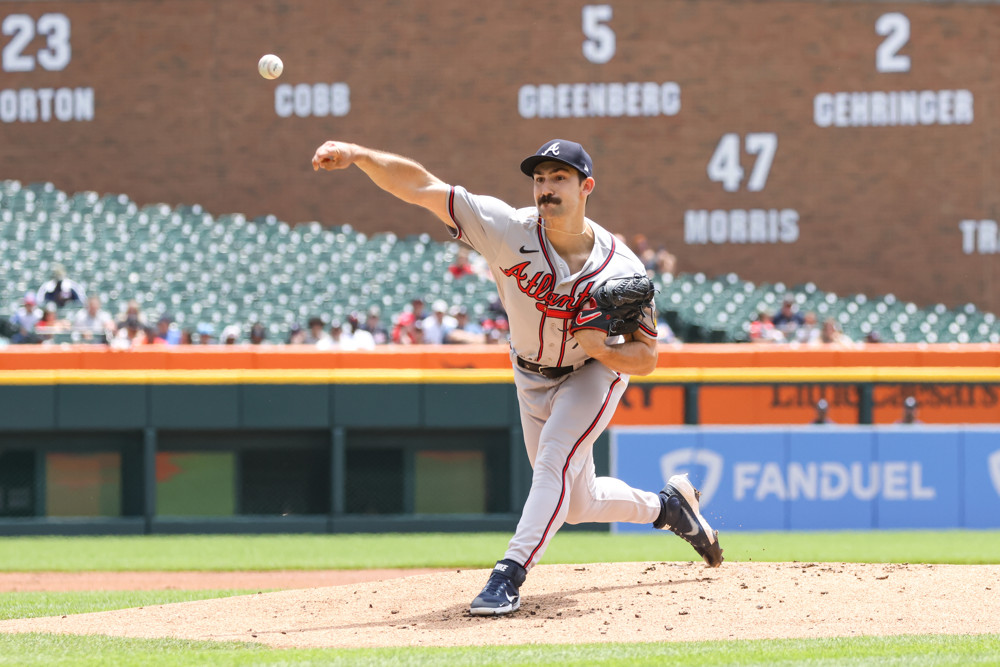
Sunday’s game presented an opportunity for a Braves sweep and, of course, Spencer Strider’s highly anticipated season debut after suffering an oblique injury.
The first box was checked with ease, as Atlanta’s offense — even without Ronald Acuña Jr. and Michael Harris II — exploded for 11 runs. Strider’s outing, however, left quite a bit to be desired.
Control Problems
From the first pitch, Strider never seemed to have command of any of his offerings. He walked the first batter he faced — who later came around to score — and finished with five walks over just 3.1 innings. Of his 87 pitches, only 48 went for strikes.
Six Punchouts
Despite the control issues, Strider was able to mitigate some of the damage. The primary reason being his ability to miss bats. Even with the velocity on his fastball not quite back to previous levels, there’s still plenty of swing-and-miss in his arsenal, which bailed him out on Sunday.
Curveball Usage
Undoubtedly the most surprising aspect of Strider’s debut was his curveball usage. This is an offering he didn’t even throw in 2024 and only began incorporating last season, when it accounted for less than 10% of his pitches. In this outing, it was easily his most featured breaking ball, used over 30% of the time and nearly twice as often as his slider, which had previously been his go-to strikeout pitch.
Velocity
Every time Strider takes the mound this season, all eyes will be on the radar gun to see if his velocity has returned to pre-injury levels. His fastball touched 97 mph early — an encouraging sign — but quickly settled into the 93–96 range after the first inning. Maintaining both velocity and command over a full outing has been an issue since his return and will likely be the biggest factor in his success this year.
Coors Field
A lot of people are going to look at Strider’s debut and jump to overreactions. It wasn’t what Braves fans were hoping to see, but it was his first major-league appearance in seven months, and the venue didn’t do him any favors. Coors Field is the most hitter-friendly park in baseball — not just because of the altitude and spacious dimensions, but also because it impacts pitch movement, making life infinitely more manageable for the guys in the box.
Time Is On His Side
Strider’s return was always going to come with growing pains. Anyone expecting otherwise hasn’t been paying close enough attention. He’ll either need to build back the strength and stamina that made his fastball a “unicorn pitch,” or adjust and evolve as a pitcher. Neither happens overnight.
The good news is the Braves have already built a cushion in the division. Combined with an elite offense, it gives them the flexibility to keep running Strider out there without the pressure of chasing ground. If Atlanta were trailing by five games instead of leading by eight, this would be a very different conversation.
—
(Photo by Scott W. Grau/Icon Sportswire)
