
Week 5 was a huge success for the column! My Locks went a perfect 4-0, moving the record to 13-5-1 on the season. Ohio State took care of business in Kinnick to keep my weekly Best Bet undefeated, both of our MAC bets were easy winners, and watch out for Baylor, who looked much healthier offensively while its defense completely overwhelmed Arizona State.
The Other Thoughts/Leans section also went 5-3, bringing that record to 21-14. Combined, we are sitting at 34-19-1. I never take weekends like that for granted in college football. The inevitable regression is coming at some point, so the goal is just to stay ahead of it as long as possible. As always, thanks to everyone who reads and tails along.
There is a lot jumping out to me on the Week 6 board, and one thing I’m paying especially close attention to is strength of schedule. At this point in the season, records and stats can be extremely misleading depending on who a team has actually played. Some teams are being undervalued because of difficult schedules, while others have built impressive records against weak competition. You aren’t always what your record says you are.
Let’s dive in, starting with my Best Bet of the week on Thursday night.
Locks: 13-5-1
Other Thoughts/Leans: 21-14
Column overall: 34-19-1
UTSA -6.5 vs South Florida
I’m laying the points with UTSA as my best bet this week. My ratings make the Roadrunners -9, so there’s some value in the number, but more importantly, I trust what I’ve seen from these two teams.
This column was a winner fading USF last weekend when Temple won outright in Tampa, and I’m going right back to the well. Until this broken Bulls offense shows me something different, I’m going to keep betting against it. Not even Temple’s poor defense was enough to snap USF out of its slump, as Michael Van Buren threw for only 205 yards and the Bulls scored 13 points. That came one week after scoring just 14 points as a 17-point favorite against Bowling Green, one of the worst teams in the FBS.
USF has now scored 21 points or fewer in three of its four games against FBS competition. The lone exception was 28 at Army, and even that required a desperation fourth-down deep ball for the game-winning touchdown in the final minute. This offense has consistently struggled to sustain drives, and I don’t think a trip to the Alamodome is where things suddenly get fixed.
UTSA’s defense has its own issues, but it has done a good job limiting explosive plays. That matters against a USF offense that already has trouble stringing together long possessions. If the Roadrunners can eliminate the cheap touchdowns and force the Bulls to consistently drive the field, I have a hard time seeing USF scoring enough to keep pace.
I’m also not buying the USF defensive numbers. The Bulls have faced FIU, Army, Bowling Green and Temple, and still haven’t seen an offense remotely as dangerous as the one they’ll face Thursday night. Army is an option offense, Bowling Green is a bottom-five FBS team, and FIU outgained USF 381-208 but repeatedly gave away scoring opportunities with turnovers. Temple averaged 5.5 yards per play last week and was inches away from another touchdown before Ajani Sheppard fumbled diving into the end zone. USF has allowed only eight touchdowns this season, but six of them have come on drives of 87 yards or longer. That’s not exactly encouraging against a UTSA offense capable of both sustaining drives and creating explosives.
The Roadrunners have been especially good on the ground behind stud back Will Henderson and rank inside the top 20 nationally in rushing success rate. Staying ahead of schedule makes this offense much more dangerous with Owen McCown, one of the more talented and experienced quarterbacks in the Group of Six.
There’s also a pretty massive difference in schedule strength. Sagarin has UTSA around 79th after trips to Texas State and Texas, plus a home game against Colorado State. USF sits around 143rd after facing FIU, Bowling Green and Temple. Even some of the Bulls’ wins have been shaky. Army led by 10 with four minutes left, Bowling Green led 6-0 entering the fourth quarter, and FIU badly outgained them in total yards. This team had been begging to lose for a few weeks before Temple finally finished the job.
Now they head to the Alamodome, where, under Jeff Traylor, UTSA is just 22-22 on the road but 35-5 at home. New USF coach Brian Hartline will make his first trip into one of the toughest environments in the AAC, on a short week, after traveling from Tampa to San Antonio. UTSA, meanwhile, played just down the road in Houston last weekend.
Hartline also gave the crowd a little extra fuel by questioning how the Alamodome gets so loud despite relatively modest attendance. UTSA responded with a $9 ticket promotion for Thursday night, so I expect the building to be rocking. That could matter against a USF team that has committed 14 penalties over its last two games. Colorado State had five false starts in the Alamodome earlier this season.
This will be Hartline’s fifth game as a head coach, while Jeff Traylor is in his seventh season at UTSA and has built this program around winning games like this at home. I expect the Roadrunners to come out fast, and if they get ahead early, I don’t trust USF’s offense to chase them down. I’ll pay to see if the Bulls can suddenly break out of this offensive slump in a hostile road environment. Until then, I’m fading them again. I wouldn’t be surprised if UTSA wins this one by double digits.
Oregon -11 vs UCLA
My ratings have done a good job this season when they show a sizable disagreement with the market, and this is another one. My ratings make Oregon -16, so I’m happy to lay -11 with the Ducks at home. I think Oregon’s stock was sold too quickly after a rough first couple of weeks. This is still one of the most talented rosters in the country, and after the early loss to Oklahoma St, the Ducks have slowly started working their way back into the national-title picture. A big win here would only help.
I think UCLA is overvalued here, mainly because of the difference in strength of schedule. Per Sagarin, Oregon’s strength of schedule sits 16th while UCLA is 48th, and the gap may be even bigger than that looks. Oregon has already played Boise State (the likely G6 Playoff team), at Oklahoma St (a budding Big 12 contender), and at USC without its starting quarterback for most of the game. I have all three rated more than a touchdown better than every opponent UCLA has faced.
UCLA’s results have been flattering once you look under the hood. They were tied with a bad Cal team entering the fourth quarter before Cal QB Jaron-Kauwe Sagapolutele injured his ankle and threw two interceptions. They were scoreless with San Diego St at halftime and led just 7-3 with eight minutes left. When they finally faced a competent offense in Purdue, they allowed 38 points, nearly 500 yards and 8.3 yards per play, and still won by 14 thanks in large part to three Purdue turnovers.
Now UCLA has to go to Autzen Stadium, one of the toughest environments in the country. Road trips to Cal or Maryland can’t prepare you for Eugene. If the Bruins start slowly again, Oregon is far more capable of turning those mistakes into points.
Both teams are off a bye week, but I like the timing more for Oregon. The bye gave Dan Lanning two weeks to prepare, and that should be especially helpful for new starting QB Dylan Raiola. Raiola looked excellent coming in cold against USC after Dante Moore was injured, going 19-of-25 for nearly 300 yards and two touchdowns. With two full weeks of preparation as the starter, I’d expect an even cleaner version of him and this Oregon offense. UCLA beat reporters have also noted that the Bruins’ man coverage remains a concern, particularly after Purdue repeatedly beat them through the air and made defenders miss in space. That’s not a good sign against a healthy, rested Ducks offense.
Another positive for Oregon is that the offensive line may finally be settling in. After weeks of rotating combinations, the Ducks appeared to find their best five against USC. That group allowed zero sacks and helped the backs average 4.2 yards per carry.
UCLA does present some problems, like Colin Hitschler’s aggressive and unpredictable defense. Bob Chesney and a few JMU transfers also have some familiarity with Oregon after playing in Autzen in the 2026 College Football Playoff. It will be the second time in 2026 that Chesney has game-planned for the Ducks. But I don’t think that familiarity is enough to overcome the overall talent and matchup gap.
I do think UCLA can score enough to keep this competitive for stretches, and the total around 59.5 reflects that. But too many times this season, the Bruins have disappeared offensively or defensively for long stretches. That hasn’t punished them against weaker competition, but on the road against a prepared Oregon team that knows it has very little margin for error, I think it finally does.
With home-field advantage and two weeks to prepare, I’ll take Oregon, who has the better offense, the better defense, and the better roster. I think this line is underselling both the spot and how talented this team is, while slightly overvaluing UCLA.
Georgia Tech +7 vs Duke
Both teams come in off a bye week, but I think this is a good situational spot to buy Georgia Tech when the market seems to have thrown them away. Duke enters 4-0 ATS, while Georgia Tech is 0-4 ATS, and that kind of split usually creates steam toward the undefeated team. That appears to be what has happened here. My ratings make this Duke -4.5, which was much closer to the opening number around -5, so I show value at +7.
Strength of schedule is playing a role in how these teams are being perceived. Duke ranks 125th nationally in schedule strength after facing only two P4 opponents, including a home game against Stanford when the Cardinal traveled across the country. Georgia Tech ranks closer to 67th and has already faced three P4 teams, including Colorado, Tennessee and its own cross-country trip to Stanford. Tulane and Illinois are down as programs from where they’ve been recently, and Duke’s wins over them just aren’t as impressive as they might have been in recent seasons.
But the biggest factor in this game is health. Georgia Tech had 18 players listed on the injury report before its last game, including eight starters. That group included its two leading tacklers, Savion Riley and captain Kyle Efford, multiple defensive linemen led by star DE Jordan Walker, several cornerbacks in the two-deep including former five-star Jaylen Mbakwe, and the Jackets’ three best offensive linemen in Ethan Mackenny, Jameson Riggs and Joseph Ionata. Starting corner Daiquan White was then injured during the game, leaving Tech without its top four corners from the preseason depth chart!
Although the latest injury report isn’t as encouraging as I had hoped, the bye week was still extremely well-timed. Captain LB Kyle Efford and DT Vincent Carroll-Jackson are both listed as probable, which would be important additions for a defense that needs to slow Duke’s rushing attack. However, Georgia Tech will remain short-handed, with some key defenders out, including DE Jordan Walker and safety Fenix Felton, as well as OL Ethan Mackenny, all ruled out. The good news on the offensive line is that key starter Joseph Ionata is not listed on the injury report and will play. Jameson Riggs and Josh Petty are both listed as questionable and would be huge boosts to that unit if they can play. Tech is certainly not back to full strength, but getting Efford, Carroll-Jackson and Ionata back would still leave the Jackets in a better spot than they were entering the Stanford game.
The low total of 44.5 also favors taking the points, and in a projected low-scoring game, a full touchdown becomes even more valuable. Duke plays at a slow tempo (bottom 20 nationally) and runs the ball roughly 60% of the time behind one of the better backs in the ACC, Nate Sheppard, who’s gaining attention for his stellar performances. That combination of tempo and style should keep the clock moving and possessions limited.
A plus for Georgia Tech has been its secondary, which ranks #27 nationally in defensive pass success rate. If the Jackets can slow Duke’s rushing attack enough to force more obvious passing situations, that could push the Blue Devils into one of Tech’s defensive strengths.
This has also been a profitable role under Brent Key. He is 3-0 against Duke and 2-0 against Manny Diaz, but more importantly, Georgia Tech is 6-2 ATS as a home underdog during his tenure, with four outright wins. This is a spot where the Jackets thrive, especially when they’re being counted out.
The market appears to be pricing Georgia Tech based heavily on its ugly start and 0-4 ATS record, but injuries played a major role in that stretch. The Jackets are still far from healthy, but I expect a motivated and desperate Tech team coming off two weeks of rest and preparation. Catching a full touchdown at home in a low-total game, I still think this is a strong buy-low spot. Give me Georgia Tech +7, and I would not be surprised if the Jackets were live to win outright.
UNLV +4 vs North Dakota State
I’ll scoop up the points with UNLV at +4, which I think is the peak of the market for NDSU. My ratings project this game at a pick’em, so I show real value in getting more than a field goal with the Rebels.
NDSU has looked extremely impressive and has taken the FBS world by storm in its first season. On paper, the Bison rank No. 2 nationally in explosiveness allowed, which could create problems for UNLV. But NDSU has played the 173rd-toughest schedule in the country, according to Sagarin, and this defense simply has not been tested by many capable offenses.
Look at the offenses NDSU has faced: two run-heavy teams in Jacksonville State and Air Force, FCS Fordham, and two of the weaker G6 offenses in Sacramento St and Wyoming. None of those teams are particularly explosive, and none resemble the fast-paced offense Dan Mullen runs at UNLV.
Compare that with the 90th-ranked schedule UNLV has faced, which includes Memphis, Hawaii (when they were healthy), North Texas and Cal. That is not exactly a murderers’ row, but it is significantly tougher than what the Bison have seen.
And while NDSU’s offense has done a good job putting points on the board, I think it will have a much tougher time in a big road environment against a UNLV defense that has performed better than expected, particularly in the secondary.
NDSU wants to control the line of scrimmage and establish the running game, so UNLV’s biggest defensive priority will be slowing down the Bison on the ground. Freshman DT Poe Purcell, who had been questionable with a knee injury, returned against Cal and recorded a tackle. The staff likes him, and his return gives a thin defensive front another body at an important time.
If UNLV can limit NDSU’s rushing attack and force the Bison into more obvious passing situations, that plays directly into the strongest area of the Rebels’ defense. UNLV’s secondary has graded among the top 10 nationally in defensive pass success rate, and I think the Rebels can have success getting NDSU off the field on passing downs.
There could also be some turnover regression coming in UNLV’s favor. NDSU is near the top of the country with a +8 turnover margin, while UNLV is roughly even. But some of that turnover production has been padded by weaker opponents, with eight of NDSU’s takeaways coming against Fordham, Sacramento St and Wyoming. Turnovers tend to regress toward the mean over the course of a season, and a road game against the best defense NDSU has faced so far could be a good spot for that regression to begin.
On the other side, UNLV’s offense appears to be finding its groove, averaging 38.5 points per game over its last two games. This is easily the best offense NDSU has faced, and I think the Bison could be vulnerable through the air.
As impressive as NDSU has looked, much of that success has come against a weak schedule. I’m not ready to trust a brand-new FBS program laying points on the road against a legitimate conference contender. I expect UNLV’s offense to have success, while the Rebels’ defense does enough to slow the NDSU running game, create some passing-down opportunities and potentially force a turnover or two. Give me UNLV +4, with a real chance for the Rebels to win outright at home.
Other Thoughts/Leans
Kent St +14 @ Western Michigan — I’ll bet on the Golden Flashes for a third straight week! I project WMU -9.5 here, and don’t think the Broncos are being priced properly after nearly losing to Buffalo. This team hasn’t looked right in recent weeks, with a blowout home loss to Boise and a near loss to Rice. With a low total of 43.5 and two super slow offenses ranking bottom 20 in seconds per play, I’ll take two touchdowns with the Flashes.
Maryland +36.5 @ Ohio St — Plug your nose here, but I only make Ohio St -31. Maybe this Maryland team has quit, but this is a good spot to fade the Buckeyes after a big road win at Iowa and then looking ahead to a massive showdown at Indiana. The Buckeyes have struggled all season to finish strong in the second half, and Maryland’s offense is capable of scoring some late points to backdoor cover in Columbus. Just give me a 45-13 score and it’ll be handshakes all around.
UTEP +10 vs Nevada — I make this Nevada -4.5, so I show a big margin. Another massive SOS difference too, with UTEP 19th and Nevada 144th. Of course, the Miners have looked awful against Oklahoma, Michigan, Oregon St, and New Mexico. Meanwhile, Nevada has beaten up on FBS bottom feeders like WKU and MTSU, while also losing at home to FCS Montana State. UTEP runs a super slow run-first offense that will shorten this game and could lead to fewer possessions. Nevada is not built for the favorite role, only 2-9 ATS as a favorite since 2022! And we just saw the Wolf Pack lose outright as a road favorite at MTSU! I’ll bank on the Miners to get up for their first home conference game.
Penn St +1.5 vs USC — I bet this one back in the summer. I know the vibes are low around Penn St, but clearly Northwestern is a decent team. And I know just the cure for a struggling offense…this USC defense! The Trojans nearly lost to Rutgers and were lucky to win at home last weekend against a very poor Washington team. There is no way I can back USC on the road, especially going cross country. Under Lincoln Riley, USC is 2-4 straight up when traveling two time zones or more, with those two wins coming against an awful Purdue team and against Nebraska’s backup quarterback. And since 2023, USC is 3-13 ATS on the road. This is also USC’s 7th straight week playing, while it’s only Penn State’s sixth, and they have an extra day of rest after playing last Friday. It all points to Penn State for me.
Georgia Southern +9 vs James Madison — Stop me if you’ve heard this before, but there’s a big SOS difference here, with JMU sitting 139th and Georgia Southern at 72nd. JMU has looked impressive under Billy Napier, but I just don’t know if they’ve truly been tested. Meanwhile, Southern has played Clemson and Houston very competitively and should’ve won at CUSA contender Jacksonville State. Statesboro should be rocking for this game, and I expect the Eagles to keep this very close in a game my ratings project only JMU -6.
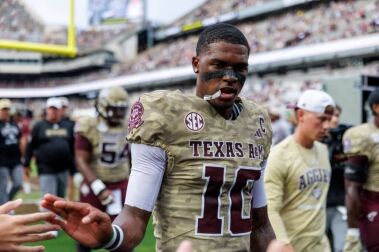
Texas A&M +4.5 @ Missouri — There’s not a ton of value compared to my ratings, which have Mizzou -2 here, but I’ll bet on the spot. It’s almost a definite letdown spot for Mizzou, who just clobbered top-ten Florida at home for a rare ranked win under Eli Drinkwitz. And I’m sure the Tigers are excited about their next matchup facing Ole Miss. For now, they’ll try to rebound for a sleepy 11 AM kickoff against Texas A&M, who’s been all sorts of disappointing this season. However, the Aggies had a get-right game last weekend in a big home win against Arkansas, and they play the Citadel next, so there’s no looking ahead. All eyes will be focused here, and I just don’t know how the Tigers respond after last week’s big win. For what it’s worth, Elko has dominated Drinkwitz over the last two years with 38-17 and 41-10 wins. A&M is live here.
—
Photo: IMAGO / Newscom World