
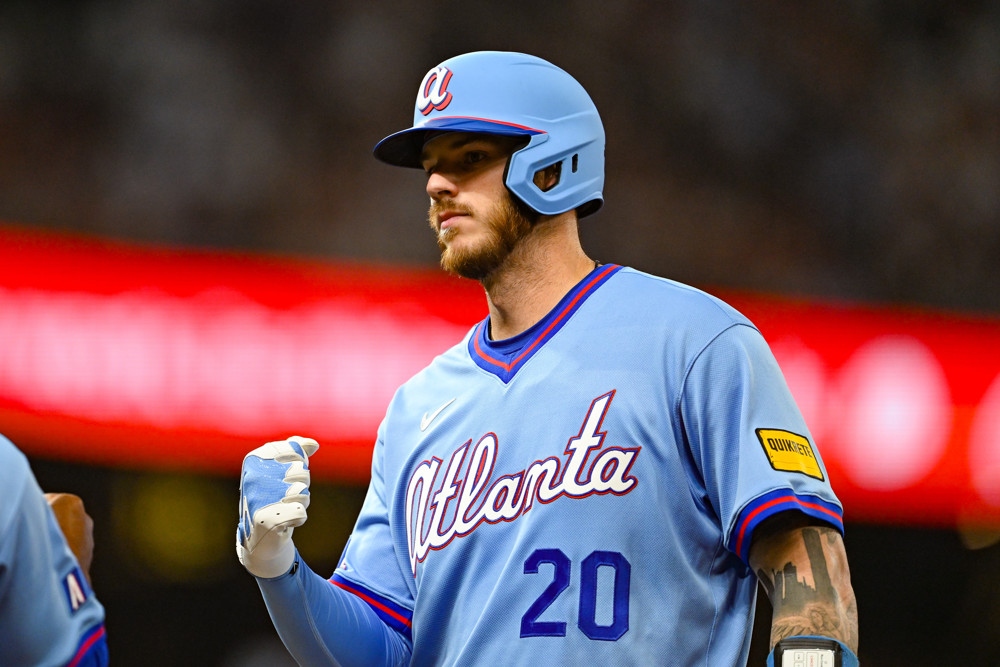
Prior to last night’s game, the Atlanta Braves activated Sean Murphy from the IL and designated Jonah Heim for assignment. That’s a tough break for a guy who had just driven in five RBIs the day before, but Atlanta didn’t have much of a choice given the roster crunch. With Michael Harris II essentially limited to pinch-hitting duties, carrying three catchers was a luxury they couldn’t afford.
The Braves likely hoped Heim would slip through waivers and remain in the organization. But a proven veteran at such a demanding position was always going to draw interest, and it didn’t take long. He was dealt to the Oakland Athletics for cash considerations right before the first pitch last night.
The #Braves tonight acquired cash considerations from the Athletics in exchange for C Jonah Heim.
— Atlanta Braves (@Braves) May 5, 2026
For Sean Murphy, it was a rough return.
Within the first 11 pitches of the game, he burned through both of the Braves’ challenges. The first was understandable — a borderline pitch that determined whether it was a leadoff walk or a strikeout. The second, though, wasn’t particularly close, and in a one-run game, that’s the kind of decision that can come back to bite you.
At the plate, it didn’t get much better. Murphy grounded into a double play in his first at-bat, then struck out twice before eventually being pinch-hit for by Michael Harris II.
Given his struggles over the last couple of seasons, the noise is going to get loud if he doesn’t produce fairly quickly. But it’s also worth remembering — this was his first major-league game since September. He deserves at least a little runway.
The biggest storyline of the night, however, had nothing to do with the catching situation. It was JR Ritchie making his third MLB start in his hometown of Seattle.
“It’s been a dream of mine to pitch at T-Mobile, take the ferry back home and then sleep in my own bed. I’m really looking forward to it. It’s gonna be a lot of fun,” Ritchie said ahead of Monday’s start.
For five and a half innings, it looked exactly like a dream come true. The command wasn’t perfect — similar to his outing against the Tigers, he had trouble getting ahead of hitters and issued a couple of early walks — but he managed traffic well and settled in as the game progressed.
Ritchie carried a scoreless outing into the fifth and recorded two quick ground-outs before things unraveled. A hit-by-pitch and two walks loaded the bases, giving Seattle its best chance of the night. Once again, though, the rookie worked out of it, getting Josh Naylor to ground-out and escape unscathed.
Then the offense gave him breathing room. Matt Olson, Ozzie Albies, and Austin Riley all went deep to open the sixth, turning a one-run lead into a four-run cushion.
That’s typically where a manager pats his starter on the back and turns it over to the bullpen. Walt Weiss went the other direction.
He sent Ritchie back out for the sixth — defensible on its own — but stuck with him after back-to-back walks to open the inning. That decision proved costly, as it led to a three-run homer before Weiss finally made the move.
The Seattle Mariners tacked on another two-run shot later in the inning off Tyler Kinley, and for one of the few times all season, the Braves’ offense didn’t have a response late, falling 5–4 in the opener.
It was easily the most questionable decision of Weiss’ first 36 games. Letting Ritchie start the inning made sense. Leaving him in after two straight walks didn’t, especially when it didn’t even buy the bullpen any rest, as he failed to record an out in the frame.
That said, over 162 games, everyone gets one wrong. And when a manager has been pushing the right buttons as consistently as Weiss has, a night like this feels more like a reminder than a concern.
—
(Photo by Rich von Biberstein/Icon Sportswire)
